Poultice
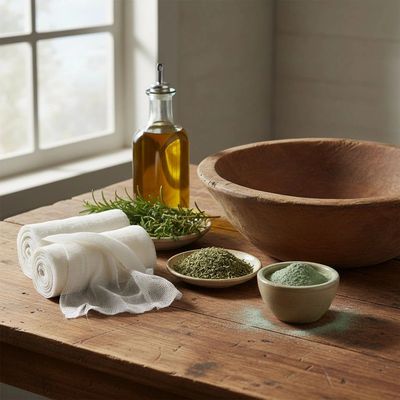
How to make a poultice
A poultice is natures own band aid. The use of poultices has been historically documented since the Edwin Smith Papyrus (c. 1600 BCE), one of the earliest known surgical texts. It explains how to clean a wound, bandage it and apply a poultice like device that treats abrasions, punctures and other types of wounds. These poultices were made of honey and animal fats. Through history knowledge has grown and poultices can be used to relieve pain, reduce inflammation, draw out infection, or soothe skin issues. There are several layers to a poultice, the active medicinal herb or spice, the binder that holds it together(flour, oats or olive oil) and the cover (gauze or paper towel) and to hold it in place an ace bandage can be used.
Poultices work on three principles
Moist heat which relaxes muscles, is a vasodilator which increases blood flow, and it soothes inflamed tissue.
Other constituents are items such as activated charcoal(A powerful absorber that pulls dirt, oil, and toxins from pores), Epsom salts (relaxes muscles and improve circulation) Bentonite & Kaolin Clays(Absorbs excess oil, dirt, and impurities)Seaweed(Rich in minerals,can be mixed with clays to boost detoxification and add antioxidants).
Herbs and spices are the medicinal agents that will heal the affected area.
How to Make & Apply
Prepare the Paste:
In a bowl mix the ingredients. The herb (for the affliction), the warmed olive oil which will form a thick paste somewhat like the consistency of thick oatmeal.
Spread on Cloth:
Using a spoon place the paste onto a clean cloth, paper towel or gauze, spreading it evenly.
Apply:
Place the cloth, paste-side down, directly onto the affected skin area.
Secure:
Cover this with plastic wrap (for moisture retention) and an ace bandage to keep it in place.
Leave On:
Leave this on for anywhere between 20 minutes and several hours. Then remove, examine the area and clean it. You can repeat this if necessary.
Uses & Precautions
Uses: Muscle aches, arthritis, sprains, minor cuts, boils, inflammation, insect bites, or to draw out splinters.
Caution: perform a skin test before you apply the poultice. check for an allergic reaction. It is always wise to consult a doctor for serious infections, deep wounds, or if pregnant/nursing.
Which herbs are good for what ailment
herbs good for inflammation are: arnica, calendula, chamomile, comfrey, dandelion, ginger, and turmeric(mixed with black pepper).
herbs good to draw out toxins and splinters: plantain, slippery elm, and marshmallow root. Activated charcoal and clay are also highly effective drawing agents especially for splinters.
herbs good for acne and eczema: Chamomile, Calendula, Aloe Vera, and Oats have anti-inflammatory and antimicrobial properties.
herbs good for cuts, abrasions and bruising: Plantain, Calendula, Comfrey, and Yarrow have anti-inflammatory, and antimicrobial benefits speeding up the healing of cuts, abrasions, bruises, and other minor injuries. In addition, Arnica (topical only) is great for bruising.